web analytics

“Decolonizing” Shakespeare 🙄

I can’t believe I wrote that headline, never mind linking to something real, not satire.

Evidently our betters have deemed Shakespeare little more than a collection of “-isms.” You can just insert an “-ism” of your choice, and chances are, Shakespeare will be a truly offensive example of it, so he must be apologized for, modified, and trigger-warning explained. The whole exercise is absurd.

This has been bubbling up for a few years already, but it just made the rounds again in my X feed so I thought I’d share. Zero Hedge links to an excellent write-up by Jonathan Turley. Enjoy… if you can do it without wincing.

“Sheikspeare”

Zerohedge, if you’re not familiar, is a alternative-to-legacy media website devoted primarily to things financial, but dips its toes in other waters with some regularity. Recently it took note of a “not very academic” 120 page article positing that Shakespeare was Middle-Eastern… Okay!

Today I received a notification from Academia.edu telling me about a piece written by Sushil K. Jain from Canada, entitled, and hold your breath, ‘Shakespeare, the Sheikh, Who Became a Peer’, subtitled, ‘The Eastern Mind Behind the English Stage: A New Model of Shakespearian Authorship’, published 2026. 

You can link to it through this X post or here.

The Movie “Anonymous”

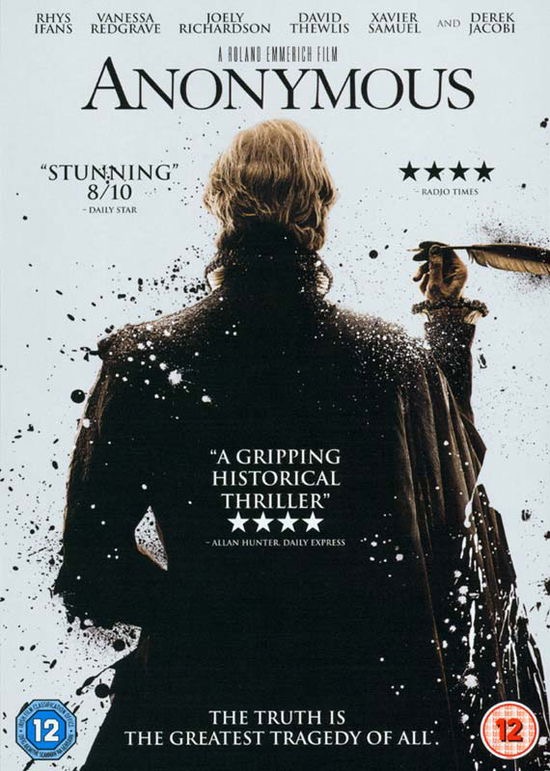
Roland Emmerich, Anonymous

The 2011 film “Anonymous” is generally viewed favorably by Oxfordians… until the end. That’s when the Prince Tudor Theory is introduced into the storyline and that’s when Oxfordians become bitterly divided.

As I have stated before, I am agnostic on the Prince Tudor Theory. I can’t deny it would very neatly explain an awful lot, so that’s extremely tempting, but neither can I deny that there are contemporaneous accounts which refute the theory.

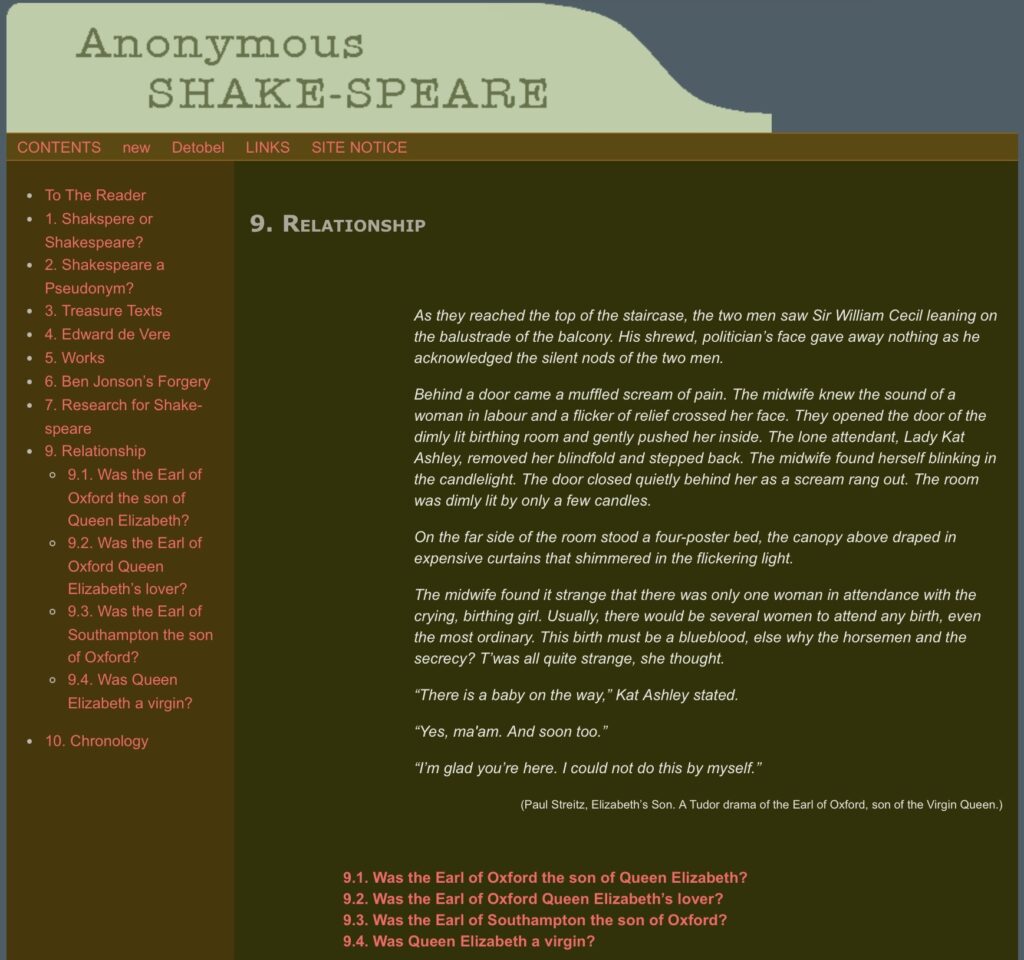
This website is an emphatic “NO” on all things Prince Tudor. It is also an emphatic “YES” on whether or not Queen Elizabeth really was “The Virgin Queen.”

Given what the historical records tells us about Robert Dudley, this seems unlikely, so the blog owner’s emphatic certainty on this matter, in my humble opinion, gives rise to doubts about his emphatic certainty on the other matter as well. That and his almost total reliance on the documentary record to prove his thesis. Of course there wouldn’t be documents proving Elizabeth mothered a child! Just as there wouldn’t be documents proving Edward de Vere is Shakespeare. We simply must look at the total record and make reasoned judgements.

Anyway, there’s more I could say about all this, but I’ll save it for another blog post on another day. I just wanted to be sure to recommend this site on The Prince Tudor theory.

AWFL Shakespeare

AWFLs (Affluent White Female Liberals) are at it again; trying to revise history using feeeeeeelings and little more. It seems a self-described “feminist historian,” Irene Coslet, has literally folded Shakespeare’s portrait and seen Emilia Bassano in it. No really.

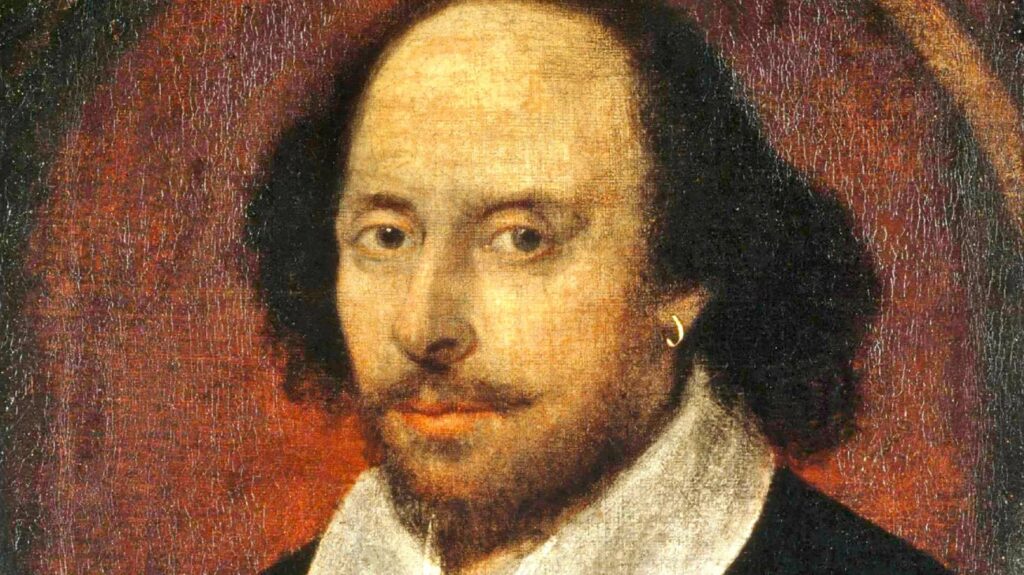
Chandos Portrait

One of Coslet’s claims is that Shakespeare’s name is an anagram of “A-She-Speaker”, and that if you fold the famous “Chandos portrait” of the playwright a certain way, it looks like the existing portrait of Bassano.

Ms. Coslet’s article is here. Two pieces about Ms. Coslet’s article are linked below. They came to my attention because one, the first, was published in American Thinker, and the other was in RealClear Books. Both are written from the Stratfordian perspective, but they are worthy of note if only for the fact that they appeared in something other than an obscure corner of the internet. In order:

Fake-speare? Claim Shakespeare was a black Jewish woman sparks backlash

Was Shakespeare really a black woman?

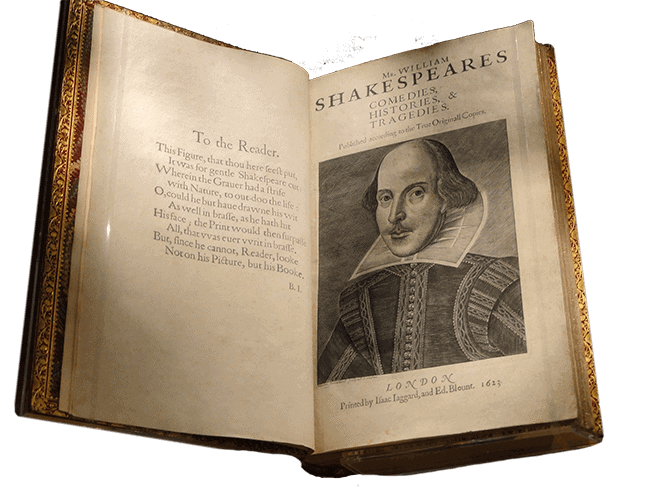
The First Folio

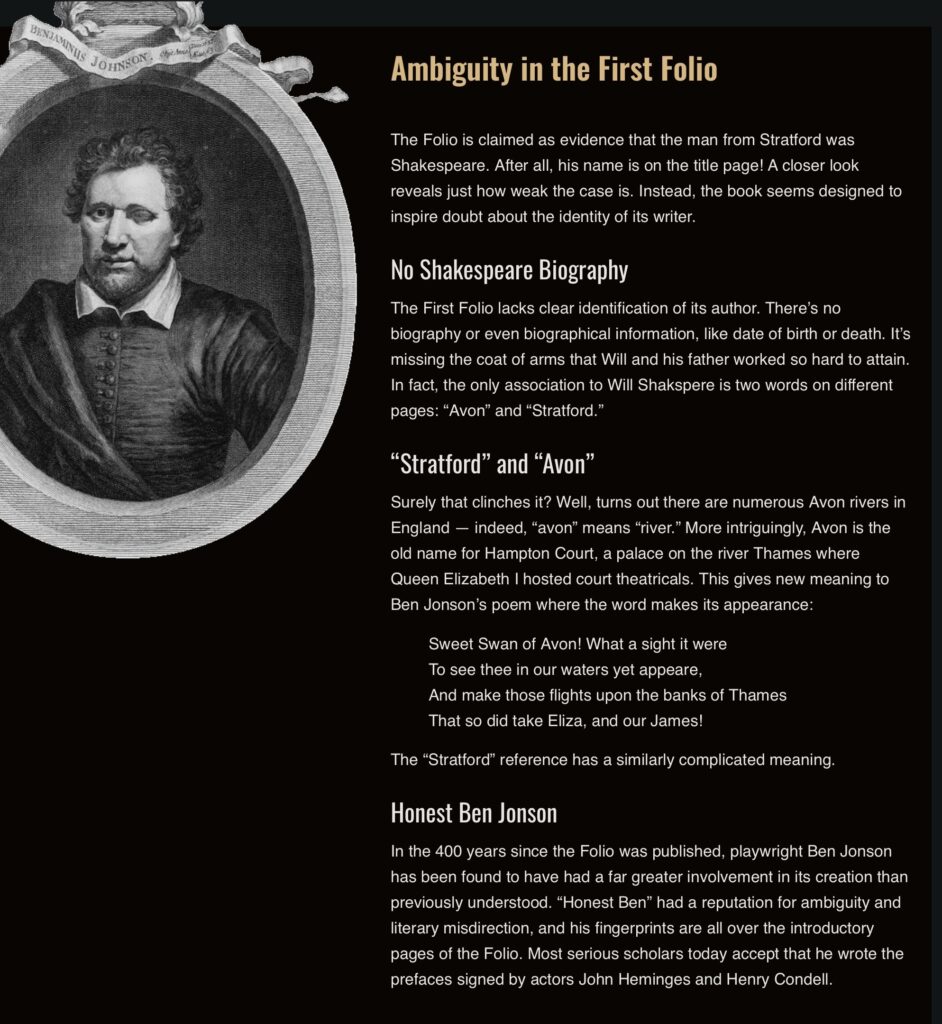
The Shakespeare Oxford Fellowship‘s website has expanded and improved dramatically over the last few years and just one of the notable improvements can be found under their “Discover Shakespeare” tab. If you scroll down and choose “The First Folio” you will land on a marvelous page which includes, among other things, an interactive graphic of the Droeshout engraving. Just above that is this information:

I heartily recommend a visit to the page to take it all in. You can find it here.

Teach it! Preach it!

The Shakespeare Oxford Fellowship has a wonderful collection of resources to spread the word to interested masses. Should you feel the desire to stand in front of a gathering of conservatives and invite them into our world, SOF has done you a solid gathering together a dozen or so templates off of which to work.

There are people who have never even heard that there is the slightest controversy surrounding Shakespeare authorship, and for those people, there is one document which is an excellent jumping off point. It’s the one entitled Why Should We Question Shakespeare’s Authorship?

Go forth and evangelize!

Article of Interest to Newbies

The Shakespeare Authorship Research Centre (SARC) was part of the now closed Concordia University in Portland Oregon. Its Director, Professor Daniel Wright, left a link behind to four articles of interest to Oxfordians, one of which is only three pages long and a wonderful introduction to newbies. It focuses on the absolute absurdity of the traditional biography and is a wonderfully satisfying read.

The Shakespeare Authorship Controversy: The Case Summarily Stated is excerpted below.

Who wrote the works of Shakespeare? Tradition reports that the author was a tradesman from provincial Warwickshire who was baptized Gulielmus Shakspere, a man who, to the best of our knowledge, never had a day’s schooling, and yet we are told – and are expected to believe – that, in his twenties, this man began to publish (having written nothing before in the whole of his life!) the most erudite works of literature the world has ever seen. We are told by traditionalists that this man (who literally could not spell his own name the same way twice) wrote poems and plays that are dense in their reliance on the literature of classical antiquity as well as Continental verse and narrative which had not even been translated into English in Shakespeare’s day. We are told that this man, who never owned so much as a single book, wrote, without any education or apprenticeship in the literary and dramatic arts, poems and plays that invoke the legends of hundreds of figures from Greek and Roman mythology – poems and plays that demonstrate the writer’s easy familiarity with and competence in Latin, Greek, Italian and French – poems and plays demonstrative of a linguistic facility so agile and confident that he sometimes would compose (as in scenes such as Henry the Fifth III. iv) in languages other than English.

When, where and from whom did this man who never traveled farther than London from his hometown, and who reputedly spent the years prior to his early marriage in apprenticeship to a butcher, supposedly learn all of this? In what educational domain did he acquire the ability to become the rarest of men: the chief wordsmith of the English language – a linguistic creator whose fecundity humbles Milton and overrides the Bible? How was it that he appeared in London, suddenly and with no preparation – like a genie from a lamp – an urbane, cultivated, accomplished, knowledgeable and unrivaled poet; a masterful practitioner of rhetoric; a scholar of his own and other nations’ literatures, histories, customs, painting and sculpture; a man intimately versed in the character of many ages’ political and religious disputes – both foreign and domestic? Where did he study astronomy, read Copernicus, become capable in the field of medicine, and demonstrate remarkable competence in and familiarity with English case law as well as Continental civil law? Where did he learn the arcane jargon of aristocratic sport and military command if all he did for the first half of his life was chop meat in a provincial and virtually bookless burg of perhaps forty families’ size (none of which families, incidentally, although they knew him well, ever acknowledged their townsman as a poet, playwright or even a writer)?

Can anyone truly think the scenario likely? Is this – a process that defies everything we know about the development of literary creativity and skill – a credible explanation of how Shakespeare attained the highest achievements in literary art? Are we seriously to believe that a man of no education, who wrote no letters (nor received any from anyone [they must have known he couldn’t read]), who wrote absolutely nothing – not so much as a mundane shopping list (and who, though wealthy, owned no books even at the end of his life) – who had no journeyman experience in the literary arts, no apprenticeship or tutelage in the classics, no foundation in music, law, statecraft, theology, aristocratic sport or courtly custom – would sit down at a desk in his mid-twenties and, in his first foray into writing, compose the works of Shakespeare? Would such a man – the world’s greatest wordsmith and lover of language – not have taught his own family to read and write rather than leave them gaping illiterates? Would the only literate member of his extended family (his son-in-law) praise, in print, fellow Warwickshire poet Michael Drayton but never write a line acknowledging that his own father-in-law was England’s most accomplished poet-dramatist (or even a writer)? Would this Shakespeare not have been feted and received tributes like his peers-rather than fail in his own lifetime to be acknowledged as a poet or playwright by anyone in letters, memorandae, dedications or diary entries?

If the writer who called himself Shakespeare were this rustic from Stratford-Upon-Avon, he is the most improbable person ever to have lived… continue here
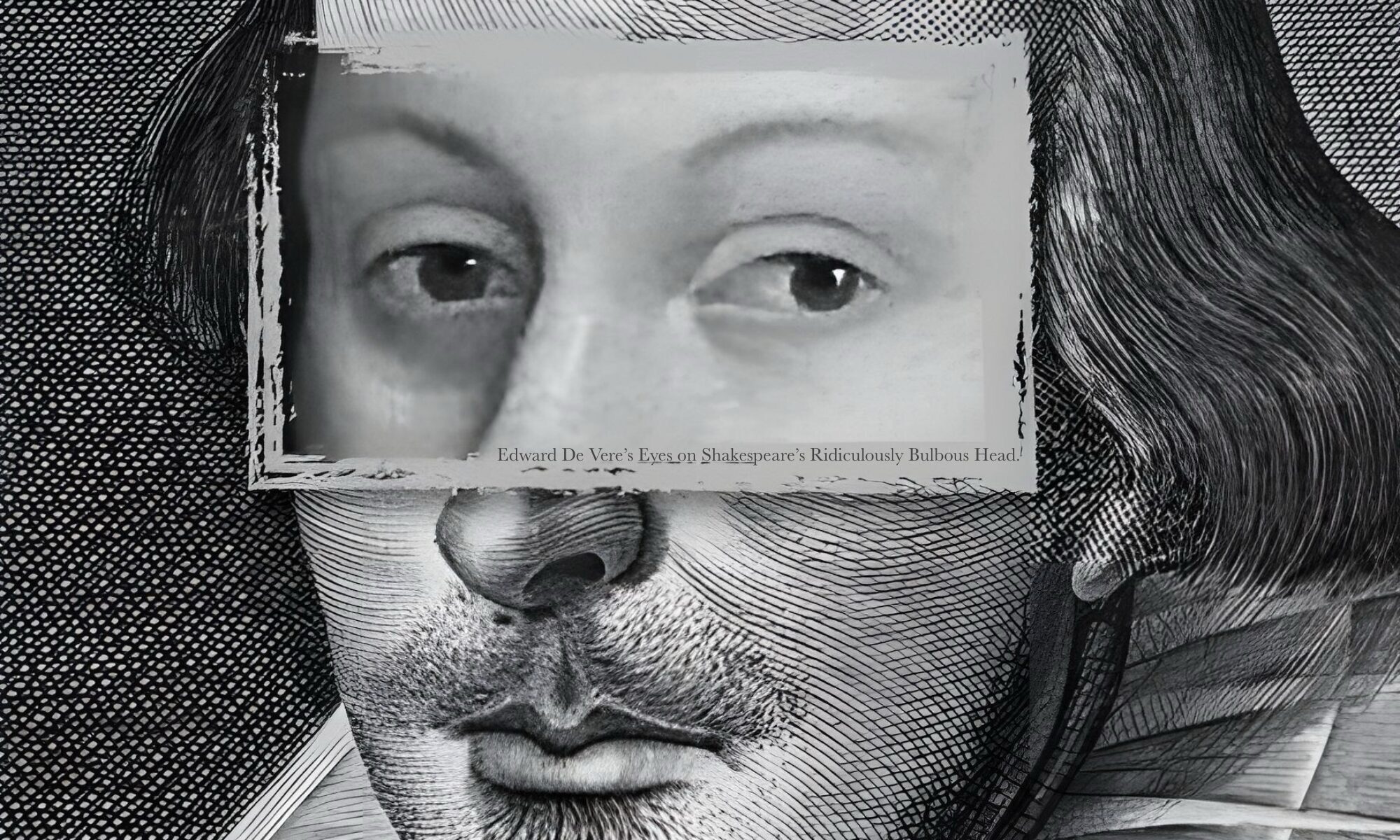
Prince Tudor Theory Letter to Editor

Here is an interesting letter on the Prince Tudor Theory I found in The Oxfordian.

What is The Oxfordian?

The Oxfordian is the peer-reviewed journal of the Shakespeare Oxford Fellowship, a non-profit educational organization that conducts research and publication on the Early Modern period, William Shakespeare and the authorship of Shakespeare’s works. Founded in 1998, the journal offers research articles, essays and book reviews by academicians and independent scholars, and is published annually during the autumn.” 

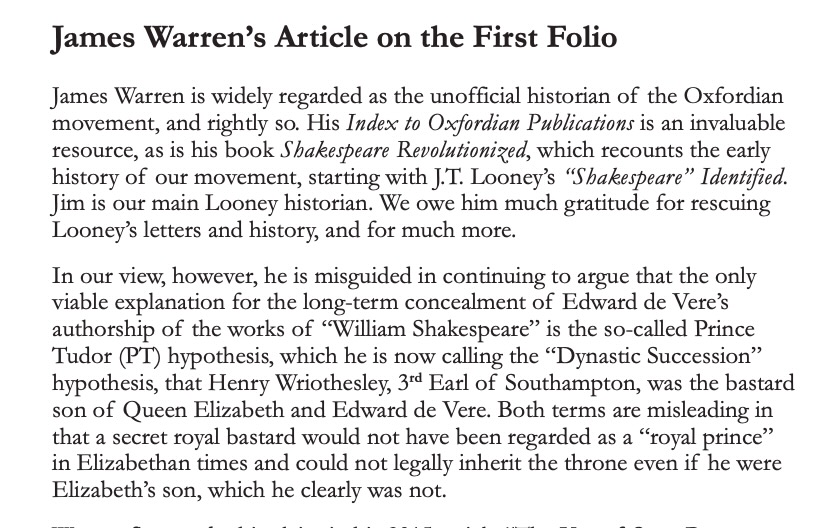
Of Particular InterestThe Oxfordian, Volume 25, October 2023, ISSN 1521-3641, 👉🏼 PAGE 9🪶 Here is an interesting letter to the editor on the Prince Tudor theory.  It is headlined:  James Warren’s Article on the First Folio.  The writer is not a believer and presents his evidence.  (Make Authorship Great Again is agnostic on the issue.). You can read it here. Scroll down to page 9. Here are the opening ‘graphs:

Malignant Progressivism at Harvard

Harvard President Alan M. Garber said the quiet part out loud in a recent interview detailed in a January 3, 2026 article in the Crimson entitled “Garber Faults Faculty Activism for Chilling Campus Debate and Free Speech.”

It begins:

“Harvard President Alan M. Garber ’76 said the University ‘went wrong’ by allowing professors to inject their personal views into the classroom, arguing that faculty activism had chilled free speech and debate on campus.

In rare and unusually candid remarks on a podcast released on Tuesday, Garber appeared to tie many of higher education’s oft-cited ills — namely, a dearth of tolerance and free debate — to a culture that permits, and at times encourages, professors to foreground their identity and perspectives in teaching.

‘How many students would actually be willing to go toe-to-toe against a professor who’s expressed a firm view about a controversial issue?’ he said.”

Harvard is hardly atypical. You can read the entire thing here.