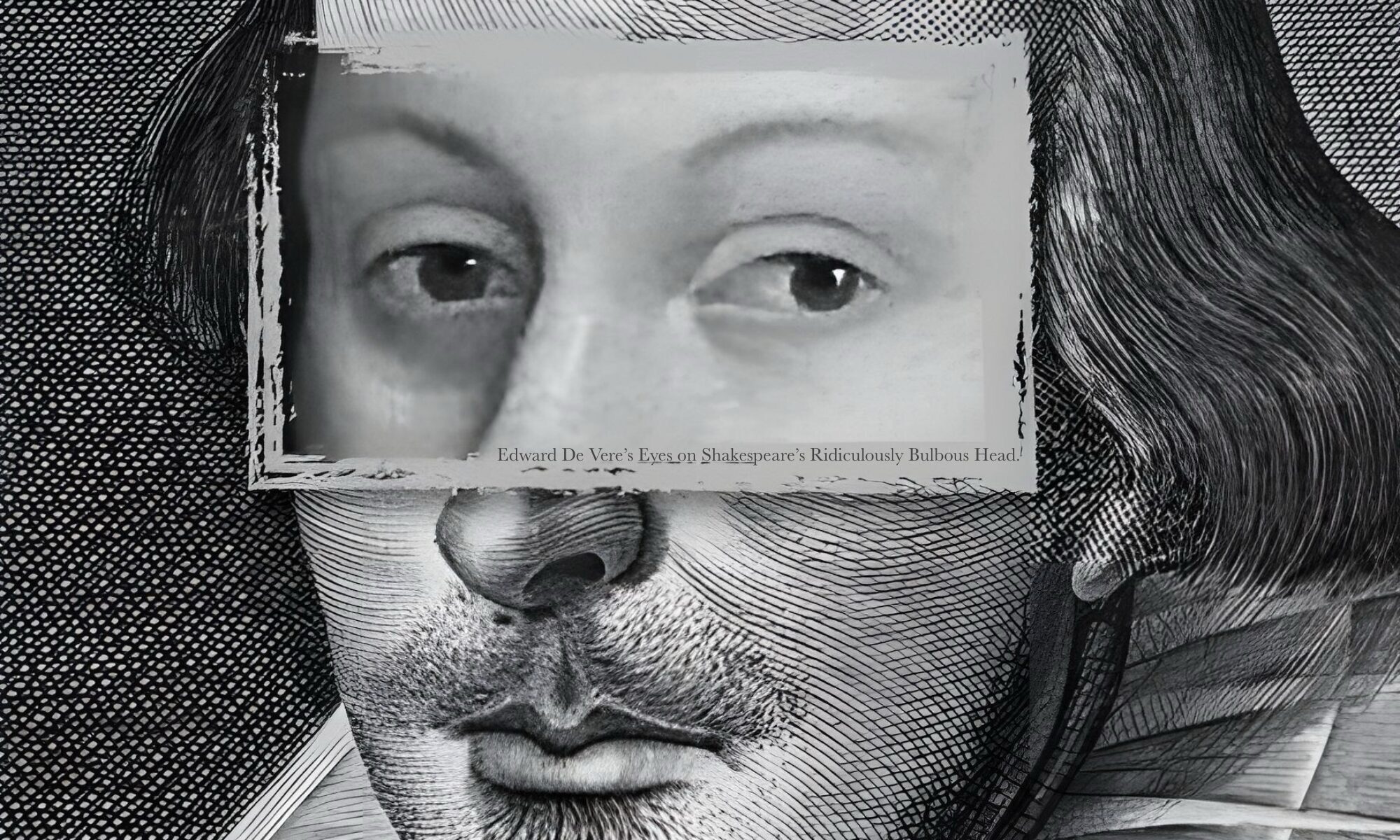

The Shakespeare Authorship Research Centre (SARC) was part of the now closed Concordia University in Portland Oregon. Its Director, Professor Daniel Wright, left a link behind to four articles of interest to Oxfordians, one of which is only three pages long and a wonderful introduction to newbies. It focuses on the absolute absurdity of the traditional biography and is a wonderfully satisfying read.
The Shakespeare Authorship Controversy: The Case Summarily Stated is excerpted below.
Who wrote the works of Shakespeare? Tradition reports that the author was a tradesman from provincial Warwickshire who was baptized Gulielmus Shakspere, a man who, to the best of our knowledge, never had a day’s schooling, and yet we are told – and are expected to believe – that, in his twenties, this man began to publish (having written nothing before in the whole of his life!) the most erudite works of literature the world has ever seen. We are told by traditionalists that this man (who literally could not spell his own name the same way twice) wrote poems and plays that are dense in their reliance on the literature of classical antiquity as well as Continental verse and narrative which had not even been translated into English in Shakespeare’s day. We are told that this man, who never owned so much as a single book, wrote, without any education or apprenticeship in the literary and dramatic arts, poems and plays that invoke the legends of hundreds of figures from Greek and Roman mythology – poems and plays that demonstrate the writer’s easy familiarity with and competence in Latin, Greek, Italian and French – poems and plays demonstrative of a linguistic facility so agile and confident that he sometimes would compose (as in scenes such as Henry the Fifth III. iv) in languages other than English.
When, where and from whom did this man who never traveled farther than London from his hometown, and who reputedly spent the years prior to his early marriage in apprenticeship to a butcher, supposedly learn all of this? In what educational domain did he acquire the ability to become the rarest of men: the chief wordsmith of the English language – a linguistic creator whose fecundity humbles Milton and overrides the Bible? How was it that he appeared in London, suddenly and with no preparation – like a genie from a lamp – an urbane, cultivated, accomplished, knowledgeable and unrivaled poet; a masterful practitioner of rhetoric; a scholar of his own and other nations’ literatures, histories, customs, painting and sculpture; a man intimately versed in the character of many ages’ political and religious disputes – both foreign and domestic? Where did he study astronomy, read Copernicus, become capable in the field of medicine, and demonstrate remarkable competence in and familiarity with English case law as well as Continental civil law? Where did he learn the arcane jargon of aristocratic sport and military command if all he did for the first half of his life was chop meat in a provincial and virtually bookless burg of perhaps forty families’ size (none of which families, incidentally, although they knew him well, ever acknowledged their townsman as a poet, playwright or even a writer)?
Can anyone truly think the scenario likely? Is this – a process that defies everything we know about the development of literary creativity and skill – a credible explanation of how Shakespeare attained the highest achievements in literary art? Are we seriously to believe that a man of no education, who wrote no letters (nor received any from anyone [they must have known he couldn’t read]), who wrote absolutely nothing – not so much as a mundane shopping list (and who, though wealthy, owned no books even at the end of his life) – who had no journeyman experience in the literary arts, no apprenticeship or tutelage in the classics, no foundation in music, law, statecraft, theology, aristocratic sport or courtly custom – would sit down at a desk in his mid-twenties and, in his first foray into writing, compose the works of Shakespeare? Would such a man – the world’s greatest wordsmith and lover of language – not have taught his own family to read and write rather than leave them gaping illiterates? Would the only literate member of his extended family (his son-in-law) praise, in print, fellow Warwickshire poet Michael Drayton but never write a line acknowledging that his own father-in-law was England’s most accomplished poet-dramatist (or even a writer)? Would this Shakespeare not have been feted and received tributes like his peers-rather than fail in his own lifetime to be acknowledged as a poet or playwright by anyone in letters, memorandae, dedications or diary entries?
If the writer who called himself Shakespeare were this rustic from Stratford-Upon-Avon, he is the most improbable person ever to have lived… continue here